Hello everyone and welcome to the Paradox Initiative.
That statement was good attention grabber? Anyway, it means nothing. I'm going to attempt to (somewhat) revive the debates thread for some good old thought provoking... thoughts. The way I'm going to do this is by examining fallacious arguments. I hope that by doing this I'll make you better as a debater and a thinker. By being able to identify a fallacious assertion, you better your chances at winning your argument, winning support from others, identifying your own positions, understanding what's fictitious in someone's argument, and constructing a coherent, effective argument.
In these arguments, I'll most likely be using math to prove things because that's how logic works; it is quite literally verbal mathematics. If you break down arguments into components, it can be represented mathematically. In fact, many arguments are used in math (think properties of equations). This is the basis of the study of Logic.
Let's begin, shall we?
Today I'll be discussing the false transitive property. No good dissection is good without first observing it's base, so I'll discuss the transitive property and why people believe it applies here.
The Transitive Property
The transitive property is the principle that
if a=b and b=c
then a=b=c
so a=c
This logically makes sense, and it does in math. However, it is limited to quantifiable things because a,b,and c MUST have values. For example, it can be used to prove that .999999(.9 repeating) = 1
First off, you can start by saying that 1= 3/3. This means 1/3 of 1 is 1/3.
Secondly, taking 1/3 of .999999 gives .333333
Therefore, from these rules you can say that
a third of 1 is 1/3
a third of .999999 is .333333
and since 1/3 = .333333 then .999999 = 1
This is an example where the transitive property works.
The Fallacy of False Transitive
Many examples of this can be seen in mathematics as well as logic. There are actually a couple of places where the transitive property can be used incorrectly and therefore be a fallacy.
The first problem can be found when one uses an incorrect version of the transitive property, or one with incorrect inputs. A good example of this is the "I'm perfect" line of reasoning
"If I'm a nobody, and nobody is perfect, then I'm perfect."
It sounds logical enough, but the problem is that the parameters in the beginning of the statement were errant. Someone can NOT physically be a nobody because everything has mass.Furthermore, this doesn't QUANTIFY but QUALIFIES which brings this outside the realm of math, making it untrue.
Using another example
Coconuts grow on islands
Greenland is an island
Therefore, coconuts most grow on Greenland..
Once again, a series of errant input statements. First, though coconuts grow on islands, they do not EXCLUSIVELY grown on islands, and furthermore the fact that somewhere is an island does not cause coconuts to grow.
EDIT***
Giants explained why this one doesn't work more thoroughly.
[20:51] ny giants: my discrete math class recently went over the concept you used on the coconut one
[20:51] ny giants: and the difference between sufficient and necessary conditions
[20:52] ny giants: such as
[20:52] ny giants: buying a lottery ticket is a necessary condition to win the lottery
[20:52] ny giants: but it is not a sufficient condition
[20:52] ny giants: sufficient means that if its true, then the outcome will be true
[20:53] ny giants: necessary means if its false, then the outcome will be false
TL;DR: You must fulfill necessary conditions for an outcome to occur but this doesn't guarantee the outcome. Fulfilling sufficient conditions are conditions that will guarantee the outcome. However, a necessary condition is not necessarily a sufficient one
End Edit*
One more example is below
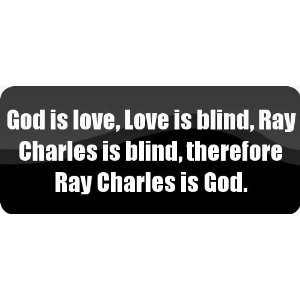
I am not an apple
God is not an apple
Therefore I am God.
This one is untrue because of the above reasons, and also instead of following
a=b b=c so a=c it uses
a≠b b≠c so a=c.
Any ≠ used in a set of logic for this reason is (for the most part in arguments) untrue because just because two things are not a different, doesn't mean they're the same thing. This is like saying a washer and a dryer are both the same because neither is a refrigerator.
The Analogic* "syllogism"
*(Ana=not, so analogic means unlogical)
This is almost exactly the same as a false transitive and is used as such. The key difference is the fact that it deals not with absolutes and quantification, as the real transitive property does, but with similarities and other properties. Most of transitives used in arguments are false for this reason.
Reasoning that if A is similar to B, and B is similar to C, therefore A is similar to C. Of course, the relation of "similar" is not transitive, but if the target can be induced to presume it is, this ruse may succeed in persuading. This is a favorite method in the "informal reasoning" used by lawyers.
This is used a lot in basketball and other athletic sports. This is like saying that
Since team 1 beat team 2
and team 2 beat team 3
then team 1 will beat team 3.
Of course this isn't true, as proved over and over by underdogs everywhere. This is because it uses a property of each team instead of the team itself. If you were saying
If team 1 is team 2
and team 2 is team 3
then team 1 is team 3
This would be correct, but why you'd want to call one team team 1, team 2, and team 3 is beyond me (this is aimed at you, Tampa Bay Devil Rays/Tampa Bay Rays)
This is also used in the "I'm Perfect" example used above.
This looks like a good a time as ever to sign off on this one
The Series Transitive Fallacy
This one's a little trickier to identify. This happens when the parts of a whole transitive property all are equal to the next one in sequence, but DON'T equal the original of the transitives. For example, if you were to say
If a=b and b=c and c=d and d=f and f=g then a=g
Then you MUST have a situation where a=b and a=c and a=d and a=f and a=g. Otherwise this statement is incorrect. This can even be shown with a mathematical application.
Courtesy of Stunt
The reason this is NOT true is that while all the parts of the proof equal the next one and the one before (technically they work in a mathematical stance), they don't work as a transitive property. This is because sqrt(4-9/2)^2 ≠ sqrt(5-9/2)^2. By making this assertion, you are quite simply saying that 4 is equal to 5 and 4≠5. This can be shown with the following proof (or common street logic)
sqrt(4-9/2)^2+9/2 = sqrt(5-9/2)^2+9/2 Subtract 9/2 from both sides
sqrt(4-9/2)^2= sqrt(5-9/2)^2 Cancel the square root and the square
4-9/2=5-9/2 Add 9/2 to both sides
4=5 This is false. Therefore 2+2≠5
However, in his proof, the parts technically work throughout but where he gets in trouble is the fact that he's working with a negative within a square root which allows him to mess with the math (this is why he used 9/2, because 4-9/2 is -1/2 which is a no-no in a square root)
End
I hope this helped you understand a little bit more about the false transitive. It was a bit of work and I rambled a little bit, but on the whole I feel this is pretty informative. I hope you enjoyed reading it!
I'll leave you with a few more pictures
-J
Pokemon
Another example of the DOES NOT EQUAL
Why women are pure evil
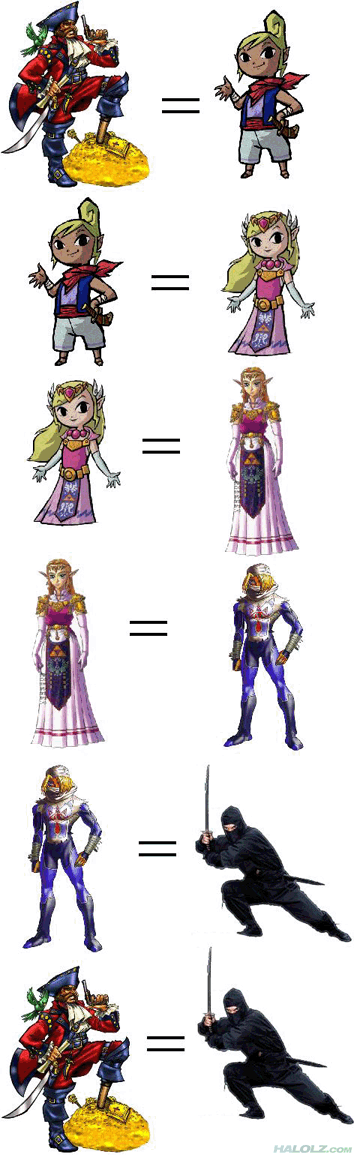
Proof that pirates are ninjas
Edited by Joshkl2013 on 03/26/2014 19:56:46
I wanna be like RAZ!!! [ZÅ]Paradox
Need a shotgun to protect you while you snipe? Call 1-800-SHOTGUN today!
Need a nuke? Call 1-800-NUKE-ALL
Take advantage of this limited offer now!
Offer expires in 3..2..1...
Edit: I skimmed it. It's a lot more than I like to think about haha, but women=problems is spot on xD.
BTW. We don't have free will. The fact that you choose whatever you think is the correct decision for you, means you will never chose the un-correct decision. If you think it's of more importance or of a better feeling to choose that un-correct decision, then it is now the correct one.
So you cannot choose what is the un-correct decision for you. So you don't have free will.
Edited by SkyDiv3r17 on 03/27/2014 14:07:58
I'd love to have more posts like this on the site. Not sure how it fits in with debates, but I won't complain!
I'm not sure that I agree with your analysis of the 2 + 2 = 5 trick. It's not really a matter of taking square roots of negative numbers since all the expressions being square-rooted are positive. In fact, it's simply a matter of the step between the first and second line being invalid.
The radical sign denotes the positive square root of a number, so sqrt((4-9/2)^2) = sqrt((-1/2)^2) = sqrt(1/4) = 1/2, which is not equal to the expression on the line above, 4 - 9/2 = -1/2. In other words, the substitution of 4 - 9/2 for that square root expression is invalid: line one reads -1/2 + 9/2, while line two reads 1/2 + 9/2. So from line two onwards, the left hand side does not equal the right hand side.
On the topic of transitivity, you may be interested in looking up non-transitive dice. It's a similar idea to that of the non-transitivity of who-beats-who in sports matches, but in a more probabilistic sense.
Also, if you do more of these, you might want to make them a little shorter.
Edited by ninja on 03/27/2014 15:48:14